
2.2.4How do algebraic manipulations help determine a limit?
Evaluating Limits
So far you have looked at limits on graphs and in terms of continuity. Today you will apply algebraic computations to determine limits and better understand graphs.
A NEW REASON TO SIMPLIFY
Yashar was trying to determine the following limit:
. When he substituted in he got . Explain why Yashar cannot determine this limit in its current form. Meanwhile Hripsime rewrote the limit as
. Explain what is happening on the graph at . Determine the value of the limit in part (b).
Explain why Hripsime’s method is useful.
Given the limits below, state the algebraic method(s) that can help you evaluate the limit.
Which problem(s) above have limits that exists and which problem(s) have limits that do not exist? Explain the graphical significance of your answer.
Evaluate the following limits.
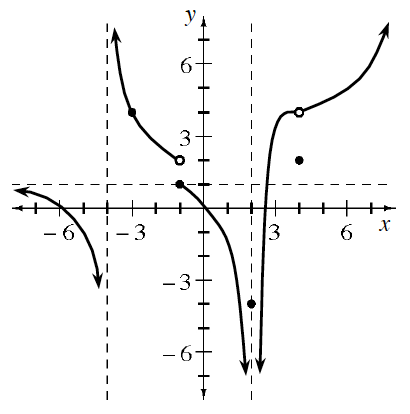
For each function below, complete the following tasks:
List all horizontal asymptotes, if any, then determine
and . List all vertical asymptotes and holes, if any, then determine
, , and .
In CPM Precalculus, limits were used to compare the magnitudes of various functions as they “raced” to infinity. It was discovered that as exponential, power, and logarithmic functions approached infinity an order of domination emerged in the race. The results are summarized below showing the order of domination.
Within each function family there exists an order of domination as well. For example, as
Exponential:
Power:
Logarithmic:
Use the idea of dominant terms to evaluate the following limits:
Evaluate each of the limits in parts (a), (b), and (c) again, but this time let
.
Use the graph of
Is the function continuous at
? Explain your reasoning using the formal definition of continuity.

Inscribed rectangles are below a curve. Circumscribed rectangles are above a curve. For the function
Calculate the area under the curve from
using four inscribed rectangles. Calculate the area under the curve from
using four circumscribed rectangles. Estimate the actual area under the curve using your answers to parts (a) and (b).
Suppose
Let
If
What are the
Let
The region bounded by


